
The agency posted five times in January. A caregiver spotlight. A hiring announcement. Three photos from a holiday party. The owner checked the page every morning for a week. 200 likes across all five posts. She felt good about it.
By February, two posts. By March, one. By April, the page sat untouched, the last update frozen on a January photo of a caregiver holding balloons.
In May, a daughter typed "home care near me" at 10 PM. She clicked through to the agency's Facebook page. Saw the last post was four months old. Clicked back. Called the competitor whose page had a caregiver spotlight from yesterday.
That pattern, the January burst followed by months of silence, I see it on nearly every home care agency Facebook page I review. The problem is never a lack of ideas or time. It's that most agencies treat Facebook like something you do when you're inspired rather than something you schedule like payroll.
This article gives you a complete Facebook calendar built for home care agencies. Not a list of tips. Not "post consistently." The actual calendar, with post types mapped to days, written for someone who has 30 minutes a week and three different audiences to reach.
Why Most Agency Facebook Pages Go Silent
There's a useful term for this: inspiration-based posting. It means the agency posts when someone feels like it, has a good photo, or remembers the page exists. The result is always the same. A burst of activity, followed by guilt, followed by silence, followed by a bigger burst when the guilt gets bad enough. Then silence again.
The pattern would be manageable if Facebook rewarded sporadic effort. It doesn't.
Organic reach on Facebook has been declining for a decade. The average page now reaches roughly 1.2% of its followers per post. If you have 500 followers, about 6 people see your post. That number gets worse when you disappear for weeks, because the algorithm interprets silence as irrelevance. When you come back and post again, Facebook shows it to even fewer people. You're starting from a lower floor every time.
Consistency isn't a nice-to-have. It's the price of admission. The good news: consistency doesn't mean daily posting. It means showing up on a schedule your audience and the algorithm can rely on.
Your Audience Is Already There
Some agency owners skip Facebook because they assume their audience is too old for social media, or that it's "just for kids." The data says otherwise.
Pew Research's latest numbers show 74% of adults aged 50 to 64 use Facebook. Among women, the number is 78%. And 54% of that 50-64 age group use Facebook daily. These aren't passive accounts. These are active users.
That 50-to-64-year-old woman is the adult daughter making care decisions for aging parents. She's the one searching at 10 PM, checking your Google reviews, and yes, looking at your Facebook page. Not to see your mission statement. To see if your agency looks alive, current, and like real people work there.
If your last post is three months old, she's already forming an opinion. Not a good one.
Three Audiences, One Page
One mistake I see constantly: agencies posting caregiver recruitment content on their main page and wondering why families don't engage. Or posting nothing but family-facing content and getting zero applicants.
Your Facebook page serves three completely different audiences. Each one is looking for something different.
Families (and the adult daughters researching for them) want to see that your agency is professional, active, and staffed by real human beings. They want caregiver introductions, educational content about home care, and social proof that other families trust you.
Potential caregivers want to see that your agency is a decent place to work. They want to see current employees who seem happy, mentions of training or appreciation, and job openings with actual details (not just "We're hiring!").
Referral sources like hospital discharge planners and social workers want to see that your agency is active and professional. They're not going to refer families to an agency whose Facebook page looks abandoned.
The calendar below balances all three. The target ratio: roughly 40% family-facing, 30% caregiver-focused, 30% community and culture. You don't need to hit those percentages precisely. You just need to avoid posting only for one audience while ignoring the other two.
A Calendar You Can Actually Use
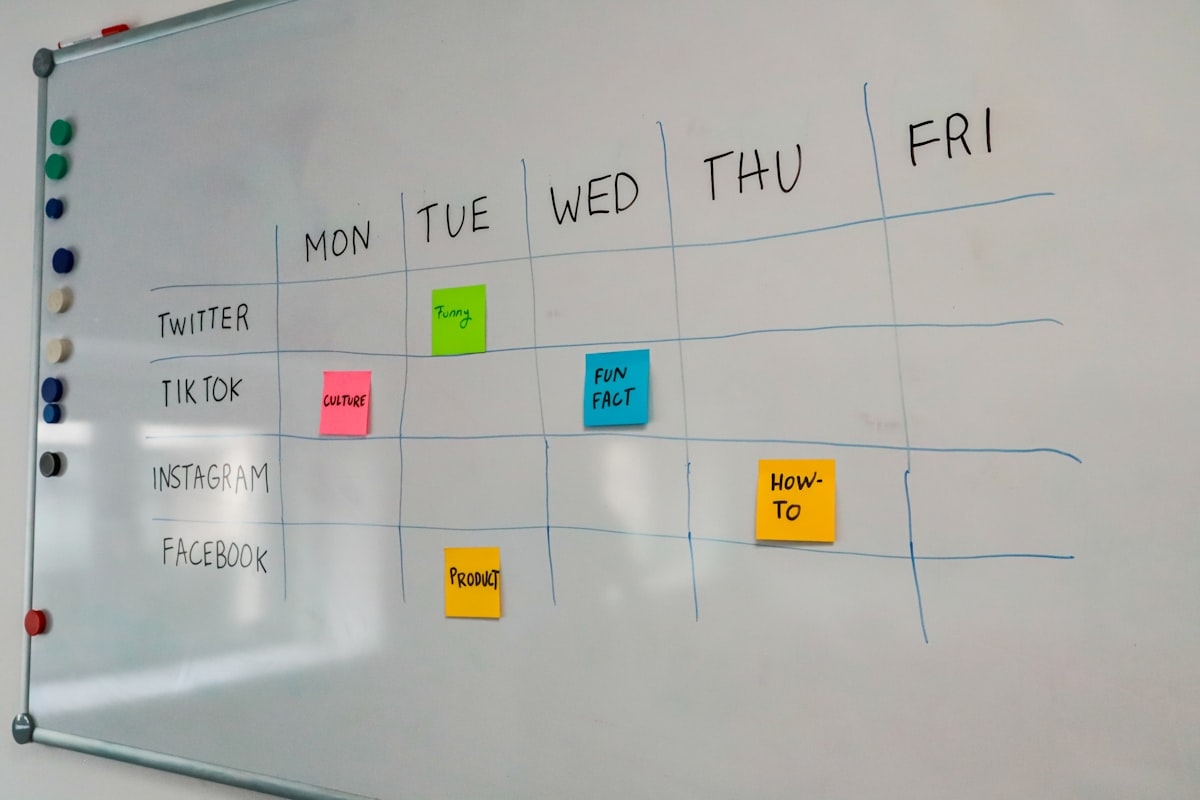
Three posts per week. Monday, Wednesday, Friday. Twelve posts per month. That's the target. Not daily posting (unsustainable for most agencies). Not one post per week (not enough to maintain algorithm reach). Three per week is the minimum viable frequency where consistency starts to compound.
Monday - Educational Tip (Families)
A short, practical tip families can use. "3 signs a parent might need help at home." "Questions to ask when touring a home care agency." "What the first week of home care actually looks like." No selling. Just useful information.
Wednesday - Caregiver Spotlight (Culture)
Introduce a team member. Not a formal headshot with a title. A photo of them at work (with their permission) and two sentences about who they are. "Meet Darren. He's been with us for 14 months and his clients say he makes the best scrambled eggs in the county." Something human.
Friday - Behind the Scenes (Culture)
A photo from the office. A team lunch. A training session. A stack of paperwork with a caption like, "Friday afternoon at [Agency]. Catching up on care plans before the weekend." The goal is to show that real people work here and the lights are on.
Monday - FAQ Answer (Families)
Take a question families actually ask during intake calls and answer it in a post. "How quickly can home care start?" "Do you do background checks?" "What happens if our caregiver calls in sick?" One question, one honest answer, two to three sentences.
Wednesday - Recruitment Post (Caregivers)
A genuine hiring post with specifics. Pay range, schedule flexibility, training provided. Not "We're hiring! Apply now!" but "We're looking for CNAs in the Scottsdale area. $18-22/hour, flexible scheduling, paid orientation. Text [number] to apply." Include a photo of your actual team, not a stock image.
Friday - Testimonial or Client Story (Families)
A family review, a thank-you note (photographed with permission), or a story about a caregiving relationship that worked well. Written consent is required. More on compliance below.
Monday - Industry Insight (Families)
Something families don't know about home care. "Most agencies can start care within 48 hours." "Home care isn't just for seniors. It includes post-surgery recovery, disability support, and respite care." Position your agency as knowledgeable, not salesy.
Wednesday - Caregiver Appreciation (Culture/Recruitment)
Celebrate a team member publicly. A work anniversary. A positive client review that names the caregiver. A "thank you" post. This serves double duty: current employees feel valued, potential applicants see that you treat your staff well.
Friday - Local Community (Culture)
Something that ties your agency to the local area. A photo from a health fair. A shout-out to a referral partner (a home health agency, a senior center). A local event your team attended. This signals roots and relationships.
Monday - Myth Buster (Families)
Challenge a misconception. "Myth: home care is only for people who can't do anything themselves. Reality: most of our clients are independent. They just need help with a few things so they can stay that way." Myth-busting posts tend to get shares because people tag family members.
Wednesday - Day-in-the-Life (Recruitment)
A short story or photos showing what a typical day looks like for your caregivers. Not the hard parts. The real parts. Driving to a client's home, helping with breakfast, sitting together in the living room. If you can do a 30-second video, even better. Short video content reaches significantly more people than static images on most platforms.
Friday - Seasonal or Best-of (Flexible)
Tie into an awareness month (National Home Care Month in November, Heart Health in February, Alzheimer's Awareness in June). Or repost your best-performing content from the month with a small update. Recycling your best content is not lazy. It's strategic. Most of your followers missed it the first time anyway.
Posts That Work vs. Posts That Don't
After building enough Facebook calendars for home care agencies, some patterns become clear.
What performs
Caregiver introductions with personal details. Not "Meet Sarah, CNA." Instead: "Meet Sarah. She drives 40 minutes each way to see her clients because she says the look on Mr. Thompson's face when she walks in is worth the commute." That story gets shares. The job title doesn't.
Short educational posts with a single takeaway. One tip. One fact. One question answered. Educational healthcare content earns over twice the engagement of promotional posts. Not because education is inherently exciting, but because it gives people a reason to share.
Real photos of real people. Phone photos outperform studio shots on Facebook. A slightly blurry photo of your team at a birthday celebration will outperform a perfectly composed stock image of a smiling senior every time. Authenticity reads. People can spot stock photos instantly and scroll past them.
What falls flat
"Happy National [Something] Day" posts. Unless the day is directly relevant to home care (National Caregiver Day, Nurses Week), these get near-zero engagement and make your page look like you ran out of ideas. If your most recent post is "Happy National Donut Day," that tells families and caregivers nothing about who you are.
"We're hiring!" with no details. A recruitment post without a pay range, location, or any specifics is invisible. Caregivers scroll past hundreds of generic hiring posts per week. Yours needs to stand out with actual information.
Long paragraphs of text with no image. Facebook is a visual platform. Posts without images get significantly less engagement than posts with photos. Even a simple phone photo makes a difference.
Overly polished graphics. Canva templates with motivational quotes over sunset photos. These read as corporate and generic. If your feed looks like a template gallery, it doesn't look like a home care agency. It looks like a marketing department, which most family members don't trust as much as a real person posting real updates.
Don't want to build this calendar yourself?
We create and manage Facebook content for home care agencies. Book a free strategy call and we'll show you exactly what we'd post for your agency.
Batch It: 30 Minutes, One Week of Content
The reason most agency owners abandon their Facebook page isn't laziness. I hear this from clients all the time. It's the daily decision: "What do I post today?" That question, repeated five days a week, burns through more mental energy than the actual posting.
The fix is batching. One sitting, once per week, all three posts created and scheduled.
Research from the American Psychological Association shows context switching, jumping between unrelated tasks, can consume up to 40% of productive time. Every time you stop what you're doing to think about a Facebook post, you're losing time getting back to the work you interrupted. Batching eliminates that.
The process takes about 30 minutes:
- Minutes 1-5: Check the calendar. See what three post types are scheduled this week.
- Minutes 5-15: Write all three captions. Keep them short. Two to four sentences each. If you're answering an FAQ, write the question and a direct answer. If you're spotlighting a caregiver, text them for a fun fact and a recent photo.
- Minutes 15-25: Find or take the photos. Use real photos from your phone. Ask your office manager or a caregiver to snap a photo during the week. Build a shared album where team members drop photos.
- Minutes 25-30: Schedule all three posts in Meta Business Suite (free). Set them to publish Monday, Wednesday, and Friday at the times your page analytics show the most activity. Done for the week.
The schedule matters more than the polish. A consistent, slightly imperfect post published on time beats a beautifully designed post that never gets published because you ran out of time to finish it.
How to Stay Compliant Without Getting Paranoid
HIPAA and client privacy stop some agencies from posting anything at all. That's overcorrecting. You can post actively on Facebook without putting your agency at risk. You just need a few simple rules.
HIPAA violations on social media are real and expensive. A group of Delaware nursing homes was fined $182,000 after employees posted photos of 150 residents without consent. Don't post client photos or details without written permission.
Get written photo consent. Before posting any photo that includes a client, get a signed release. Keep it simple. One page. "I give [Agency Name] permission to use my photo on social media." Store it with the client file. No signature, no photo.
Never mention client health details. "Mr. Johnson is doing great after his stroke" is a HIPAA violation even if Mr. Johnson gave you verbal permission. Written stories should be generalized: "One of our clients recently told us..." or use the client's first name only with written consent that specifically covers social media.
Caregiver content is safe territory. Photos of your own employees at work (in non-client settings), team events, office activities, and general educational content carry no HIPAA risk. When in doubt, post about your team, not your clients.
Reviews and testimonials need consent too. If a family leaves a Google review and you want to screenshot it for Facebook, get permission first. If they wrote it publicly, you can usually share it, but a quick message asking "Mind if we share this on our page?" builds goodwill and avoids complaints.
What Good Actually Looks Like
Realistic expectations prevent burnout. If you're an agency with 300 to 800 Facebook followers, this is what "success" looks like after 90 days of consistent posting:
- Reach: Each post reaches 20-60 people organically. That sounds small. It is small. But over 12 posts per month, you're putting your agency in front of 250-700 people regularly. Some of those are family members who will also check your Google reviews.
- Engagement: 2-10 reactions and 0-3 comments per post is normal. Small pages (under 5,000 followers) average a 0.30% engagement rate, which is actually double the platform average. Your size is an advantage here.
- Leads: Facebook is not a lead generation machine for most home care agencies. It's a trust-building machine. The lead comes when someone Googles you, finds your website, and then checks your Facebook to see if you look real. A live, active page confirms what your website claims. A dead page raises doubt.
- Recruitment: Caregiver recruitment posts with specific details (pay, location, schedule) will generate 1-5 inquiries per post in most markets. That adds up. Over a month, 4-8 recruitment posts can produce a steady trickle of applicants without paying for job board postings.
If you want Facebook to generate direct leads, that requires paid advertising, which is a completely different conversation. Organic Facebook builds the foundation that makes paid ads work better when you're ready for them.
The Ultimate Marketing Checklist for Home Care
15-point GBP audit, review generation templates, recruitment ad examples, website conversion checklist, and social media calendar.
No spam. Unsubscribe anytime.Want Us to Handle Your Facebook?
We build and manage social media for home care agencies. Content calendars, posting, engagement, the whole system.
If you'd rather hand this off to people who already know what works, let's talk.
Get a Free Strategy CallQuick call. We'll look at your current page and tell you exactly what we'd change.
Most agencies don't fail at Facebook because they lack creativity. They fail because they don't have a system. A calendar removes the daily "what should I post?" question. Batching removes the time excuse. And showing up three times a week, even with imperfect content, puts you ahead of the majority of home care agencies whose pages are collecting dust.
Print the calendar. Block 30 minutes on Monday morning. Schedule the week. Do it again next Monday. That's it. It's not glamorous, but the agencies that stick with it for 90 days start seeing results the ones who post randomly never will.