
9 minute read
A daughter sits in the hospital cafeteria, scrolling through her phone while her mother recovers from a fall. She's Googling "care homes near me" and clicking through to Facebook pages. What she sees in the next 30 seconds will shape whether she calls your facility or moves on to the next one.
Your social media feed isn't just marketing. It's a window into daily life at your care home. And right now, most facilities are getting it wrong.
Scroll through enough care home Facebook pages and the pattern becomes predictable: a flurry of posts in January, awkward silence through February, then a desperate "Happy Mother's Day" graphic pulled from a stock image library. That's not a content strategy. That's neglect with occasional guilt.
The good news? You don't need a marketing degree or hours of spare time. You need a rhythm. A repeatable framework that turns daily life into content families actually want to see.
Why Daily Life Content Beats Polished Marketing
Here's something I think most care home marketers get backwards: families aren't looking for polish. They're looking for proof.
Proof that residents are engaged. Proof that staff care. Proof that the place feels like home rather than an institution.
The data backs this up. Video posts on Facebook generate 59% more engagement than photos or text updates. But here's the part that matters: those videos don't need fancy editing. A shaky smartphone clip of residents singing along at a music session outperforms a professionally shot facility tour almost every time.
Why? Because the shaky clip feels real. It's evidence of life happening.
What Actually Goes Viral
Wheatland Manor, a senior living community, created a simple campaign called "Advice for the Younger Generations." They photographed residents holding whiteboards with handwritten wisdom like "Get a job you enjoy" and "Play Uno with your grandma."
No budget. No production team. Just a whiteboard and genuine residents.
The campaign went viral, racking up thousands of shares and putting a facility that most people had never heard of in front of millions of eyeballs. The content worked because it showcased personality, not amenities.
Not every post needs to go viral. But authenticity beats production value in this space. When I look at care home Facebook pages that get any real engagement, the top performers are almost never the ones with professional photography. They're the candid moments: a resident blowing out birthday candles, a therapy dog visit, staff members laughing during a break.
Don't have time to post consistently?
We manage social media for care homes so you can focus on residents. Book a free consultation to see if we're a fit.
The Platform Question: Where to Focus Your Energy
You don't need to be everywhere. In fact, spreading yourself across five platforms is a recipe for doing none of them well.
Recent analysis of care home social media presence found that Facebook accounts for 53% of total followers across the sector. LinkedIn comes in second at 37%, but that's mostly relevant for recruitment and B2B referral partnerships rather than family engagement.
For reaching families making care decisions, Facebook is still the primary battlefield. And the numbers explain why:
- 78% of adults aged 30-49 use Facebook according to Pew Research, the highest rate of any age group. These are the adult children making care decisions for aging parents.
- 59% of adults 65 and older use Facebook, making it the dominant platform for seniors themselves.
- Adults 65+ have a 3.42% click-through rate on Facebook video ads, compared to just 1.05% for 18-24 year olds. Older audiences actually engage more, not less.
Start with Facebook. Get that right. Then consider Instagram for the visual storytelling component. Leave TikTok alone unless you're specifically trying to recruit younger caregivers.
The 7-Day Content Framework
Here's the framework I recommend for facilities with limited time and no dedicated marketing staff. It's not rigid, but it gives you a structure to build around.
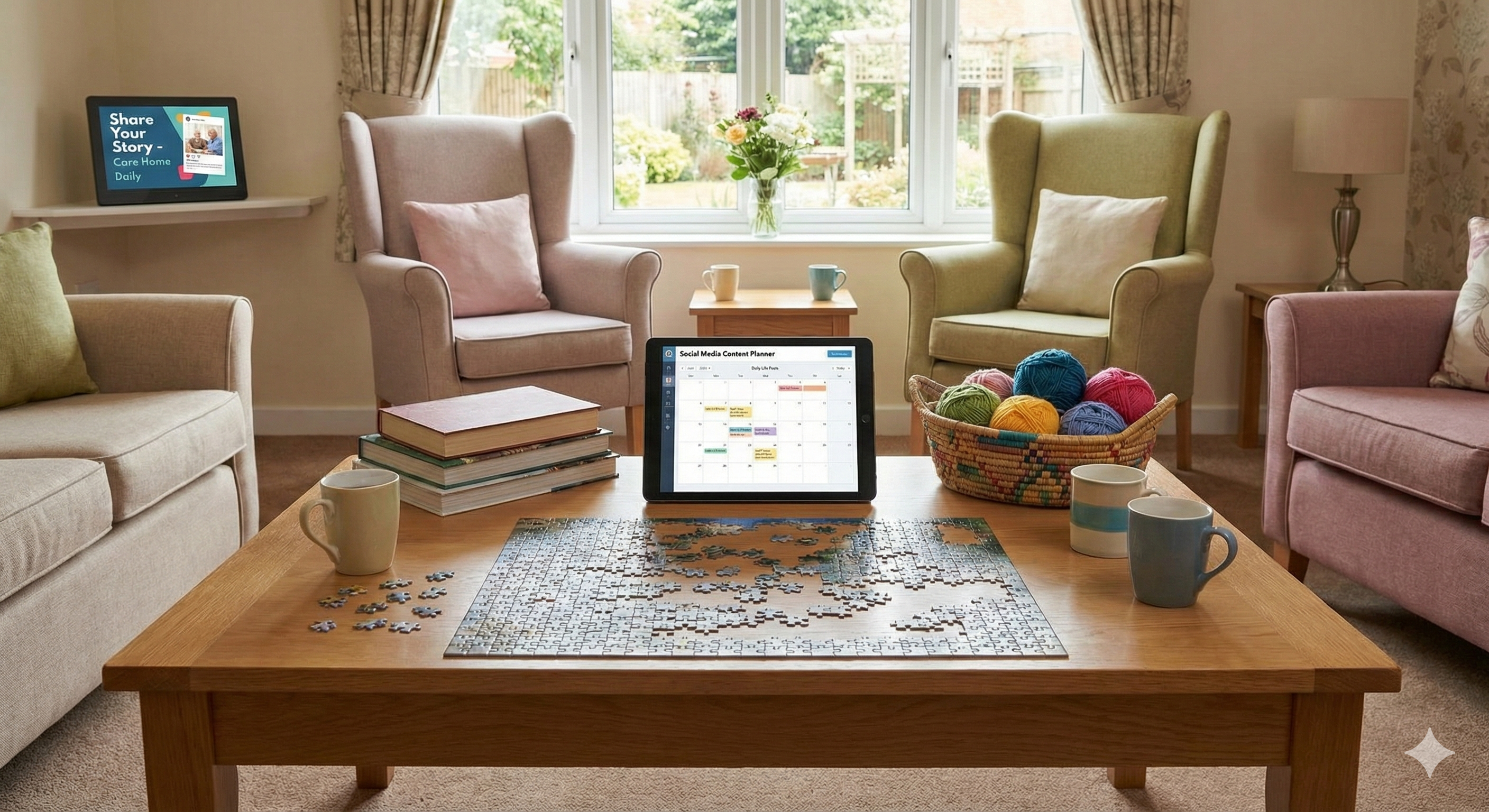
Weekly Content Calendar Template
| Day | Theme | Example Post |
|---|---|---|
| Monday | Week Ahead Preview | "This week at [Facility]: Tuesday bingo, Wednesday therapy dog visit, Friday sing-along. Stop by and see us!" |
| Tuesday | Resident Spotlight | Photo of Margaret with caption: "Margaret worked as a nurse for 40 years and still loves watching medical dramas. Her favorite thing about living here? The garden walks." |
| Wednesday | Activity Recap | Short video or photos from an activity. "Our painting class this morning. Some of our residents are working on pieces for the spring art show." |
| Thursday | Staff Feature | "Meet James, our activities coordinator. He's been with us for 7 years and has never missed a Thursday trivia night." |
| Friday | Community Connection | Photos from volunteer visits, local school partnerships, or community events. Tag local organizations. |
| Weekend | Rest or Throwback | Optional: "Throwback Thursday" style post from facility history, or simply take a break. |
Pro tip: Batch your content. Take photos throughout the week, then schedule everything on Monday morning. Tools like Meta Business Suite let you schedule Facebook and Instagram posts for free.
This gives you 4-5 posts per week, which hits the recommended frequency without burning out your team. Research from Hootsuite suggests the best times to post for healthcare organizations are 4-6pm on Tuesdays and Fridays for Facebook, and 8-10am Tuesday and Friday mornings for Instagram.
But honestly? Consistency matters more than timing. A post at 10am every day will outperform erratic posting at "optimal" times.
What Content Actually Gets Engagement
Not all content is created equal. Here's what I've seen perform best, ranked roughly by engagement potential (and if you're wondering what families actually want to see from your agency, that applies here too):
Video content wins. Even short, imperfect clips. A 30-second video of residents doing chair exercises or a therapy dog making the rounds will outperform almost any static image. Facebook users are 4 times more likely to watch a live stream than a pre-recorded video, so consider going live for special events.
Resident stories beat facility features. People connect with people. "This is our new dining room" gets a fraction of the engagement of "This is Rose, enjoying her 95th birthday lunch in our dining room."
Food performs surprisingly well. It sounds odd, but meal photos and cooking demonstrations consistently get shares and saves. Families want to know their parents are eating well.
Intergenerational content goes viral. Photos of local schoolchildren visiting, high school volunteers helping with activities, or grandkids visiting tend to get shared widely. It signals that your facility is connected to the broader community.
Staff appreciation resonates. Celebrating a staff member's work anniversary or sharing their story builds trust. Families want to see that you have stable, caring employees who stick around.
The Privacy Landmine You Can't Ignore
Here's where I need to be direct: posting photos of residents without proper consent isn't just unethical. It's illegal, and the penalties are serious.
In a recent enforcement action, a Delaware nursing home chain was fined $182,000 and placed on a two-year compliance program after posting photos of approximately 150 residents without proper authorization. The facility thought they had consent. They didn't have HIPAA-compliant authorization.
There's a difference. Simple consent, even in writing, often isn't enough. A valid HIPAA authorization must include:
- A specific description of what will be disclosed (photos on Facebook, for example)
- The purpose of the disclosure (marketing, community updates)
- An expiration date or event
- The right to revoke the authorization
- A statement that information may be re-disclosed
For residents who lack capacity to consent, you need authorization from their legal representative. Given that research suggests around 40% of residential care residents may lack decision-making capacity, this applies to a significant portion of your population.
Before You Post Any Resident Photo
Ask yourself:
- Do I have a signed, HIPAA-compliant media authorization on file?
- Does that authorization specifically cover social media?
- If the resident lacks capacity, did their legal representative sign?
- Is the image dignified and appropriate?
When in doubt, photograph activities without faces, or use stock images. No social media post is worth a six-figure fine.
This sounds restrictive. But it's not actually that hard to build consent into your intake process. The facilities I've seen handle this well make media authorization a standard part of admission paperwork, revisited annually. Once the system is in place, it runs itself.
The Mistakes That Kill Your Feed
I see a few patterns show up consistently in the care home social media feeds that struggle. These are the most common problems:
Abandonment. An inactive page is worse than no page at all. If someone lands on your Facebook and sees your last post was eight months ago, they assume you're closed, struggling, or don't care. If you can't commit to at least weekly posting, consider taking your page down entirely.
Over-promotion. Every post being a sales pitch for your services. "We have rooms available! Call now!" might feel productive, but it drives people away. The 80/20 rule applies here: 80% informative or engaging content, 20% direct promotion at most.
Ignoring comments and messages. Social media is social. When a family member comments "Mom looks so happy here!" and you don't respond, you've missed an engagement opportunity. When someone sends a message asking about availability and you take four days to reply, you've probably lost a lead.
Spreading too thin. Some facilities maintain Facebook, Instagram, Twitter, LinkedIn, TikTok, and YouTube channels simultaneously, with all of them looking neglected. Pick one or two platforms and do them well.
Stock image overload. Those generic photos of smiling seniors in pristine settings feel false to families. They know what care homes actually look like. Real photos of your actual facility, even if less polished, build more trust than any stock library.
Making It Sustainable
The biggest barrier I hear from care home managers isn't lack of ideas. It's lack of time. Between compliance, staffing, and daily operations, who has bandwidth to think about Facebook?
Here's how to make this manageable:
Assign a "social media point person." Not necessarily someone with marketing experience. Just someone who enjoys it. Activities coordinators often make great candidates since they're already photographing events. Give them 30 minutes twice a week. (Similarly, when it comes to your website's homepage, having one person own the key elements makes all the difference.)
Build a photo bank. Keep a shared folder where anyone can drop photos from activities, visits, and daily life. When it's time to post, you have material ready.
Batch your scheduling. Use Meta Business Suite (it's free) to schedule a week's worth of content in one sitting. Monday morning: schedule five posts for the week. Done.
Repurpose what works. If a resident spotlight got great engagement three months ago, that style works. Do another one. You don't need to reinvent the wheel every week.
Accept imperfection. This isn't brain surgery. A typo in a Facebook post won't kill anyone. The bar for "good enough" in care home social media is honestly pretty low, because so many facilities do nothing at all. Showing up consistently puts you ahead of most competitors.
The Ultimate Marketing Checklist for Home Care
15-point GBP audit, review generation templates, recruitment ad examples, website conversion checklist, and social media calendar.
Get the Free ChecklistRather Have Professionals Handle Your Social Media?
We showed you how to do it. But if you'd rather hand it off entirely, that's what we're here for. We manage social media for care homes so families see proof of the life you're providing.
Book a Free Consultation15 minutes. No pressure. Just an honest look at whether we can help.
Families choosing a care home for their parent want one thing above all else: to know their loved one will be seen, valued, and cared for as an individual.
Your social media feed is where you prove it, one post at a time.